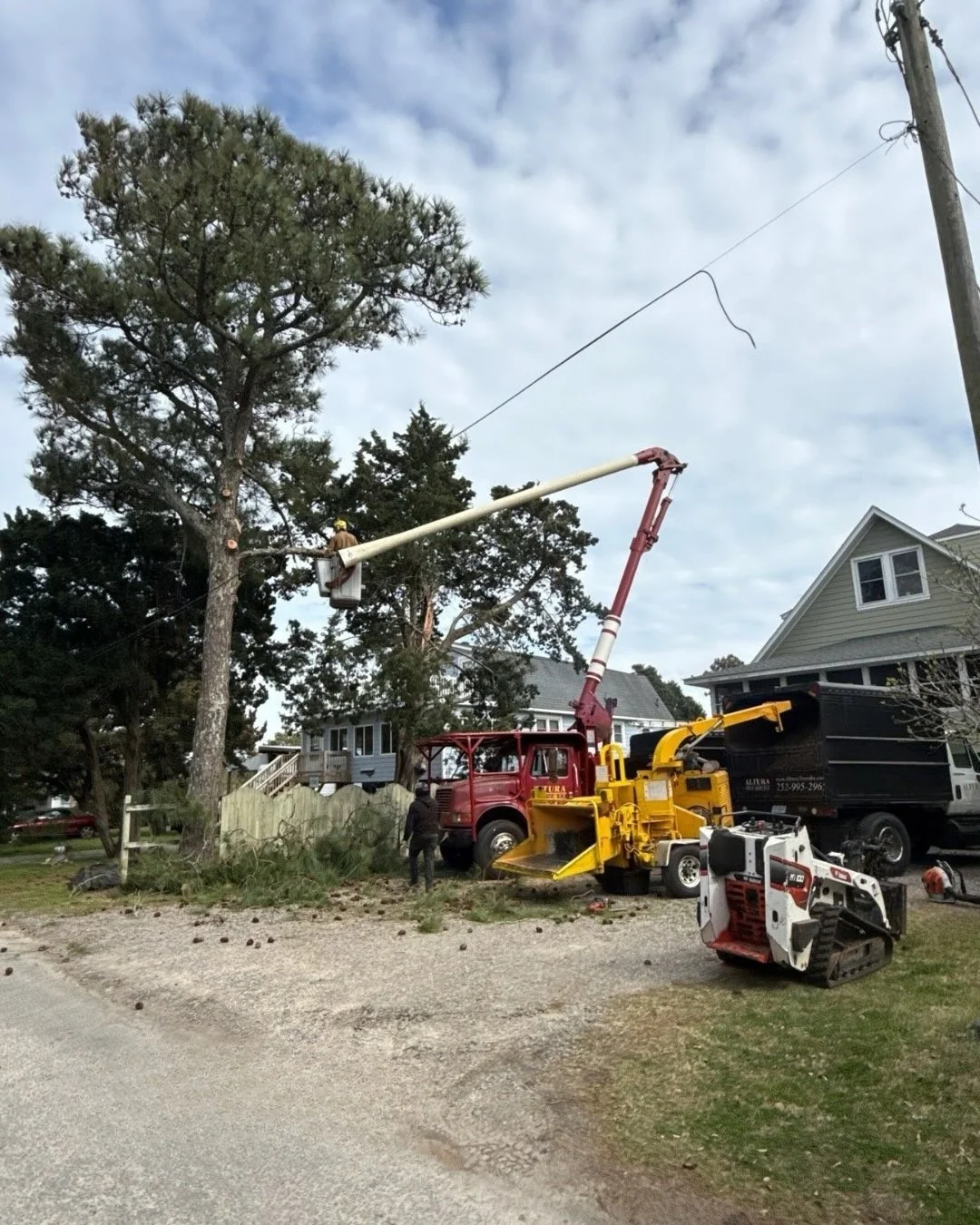
Tree Removal in the
Outer Banks, NC
Tree removal on tight Outer Banks lots, planned around your house, your rental calendar, and your land.
Local work. A thoughtful plan.
Altura Tree Service is a Hatteras Island tree company that removes trees across the Outer Banks, from Ocracoke up to Kitty Hawk. Our goal is to put as much of each tree as we can back into your land. We take out the trees that are hurting your property or causing liability and we aim to leave trees that are supporting your property. Rose Houska puts it simply: "We are in tune with the coastal landscape and its unique needs."
We're local in the everyday sense. We buy our gas from Jarvis and our tools from Kempville's in Buxton, we aim to hire people who live here, and we make the ferry trip to Ocracoke, where most tree services don't go.
Most of our calls come from vacation homeowners, property managers looking after rentals, full-time residents with a dead pine in the yard, and builders clearing room for a new house. The job is almost never just the tree. It's the house on pilings beside it, the septic field under it, and the guests showing up on turnover day. If you're not sure the tree needs to come out, compare removal, trimming, and hazard work.
When does a tree need to come out?
A tree needs to come out when it's dead, killed by pests, invasive, in the way of a build, or worrying you every time the wind picks up.
Here's what each one looks like when we show up:
Dead trees. A dead tree gets weaker every month it stays up. The wood dries out and turns brittle, limbs drop without warning, and it gets harder for the crew to rig safely. Dead wood also draws pests like carpenter ants.
Pines killed by pine bark beetle. If a black pine's needles are turning brown, pine bark beetle may have already killed it. The beetle is wiping out black pines across Hatteras Island, and we're removing them in the tri-villages right now. A beetle-killed pine is a dead tree, and it comes down better on your schedule than on its own.
Trees in the way of a build. If you're building, trees too close to the footprint have to come out before the pilings go in. Digging for the foundation takes the roots with it, so a tree left standing at the edge rarely survives the build. We clear the footprint and the rest of the lot ahead of the builder.
The worry tree. If a tree has you worried every time the wind picks up, that's reason enough to have us look at it. Altura would rather take a worry tree down at a fair price than leave you watching it through the window. If it's leaning toward the house right now, that's hazard tree removal.
What about invasive trees?
The best way to maintain invasive trees is to call a professional. The Tree of Heaven and Thorny Olive are the two invasives to take out. Both spread fast and crowd out the native trees that block the wind and hold the ground in place.
Tree of Heaven won't go away if you just cut it down. It spreads through its roots and through seeds birds carry off, and it grows right back from the stump. We cut it and treat the stump so it stays gone.
Thorny Olive is usually better removed than pruned. Its branches weave together into what Altura calls a basket weave, so trimming barely makes a dent. A lot of people here call it Russian Olive, and it was first planted to hold highway ditches in place. If you want a windbreak in its spot, Altura recommends Pittosporum, which stands up to the wind and keeps a clean, even shape.
What happens to the wood?
Most of it can stay on your property and support the land around your house. Branches get chipped, logs get set aside, and both can build back deteriorating land. Anything you don't want, we haul off, but hauling doesn't have to be the default.
Our chipper takes logs up to 16 inches, so most of a tree can turn into chips right there in the yard.
The Altura crew can spread chips made from your trimmings, which give grass roots something to hold onto. This can help keep the land from washing out Logs laid along a slope or a property edge, covered with branches and soil become a hugelkultur berm. As the wood breaks down, the berm holds water and builds up ground in the spots where wind and rain keep wearing it down. Altura calls this land accretion, and it's a long-term fix for land cultivation.
You don't have to live with the stump, either. Once the tree is down, we can grind the stump out so the spot can go back to being lawn, garden, or a new tree.
There's one thing we won't do with the wood: burn it if poison ivy is growing on it. The smoke carries the oil, and it can hurt anyone who breathes it.
Why can’t the root ball go through the chipper?
Because it's full of sand. On a barrier island, a root ball comes out of the ground packed with sand and dirt, and that grit ruins a chipper's knives and anvil. That makes root balls the one part of the tree we can't turn into chips. We can grind the stump down below grade and in a few months, you won’t even be able to tell there was a stump.
How do you remove a tree close to a house?
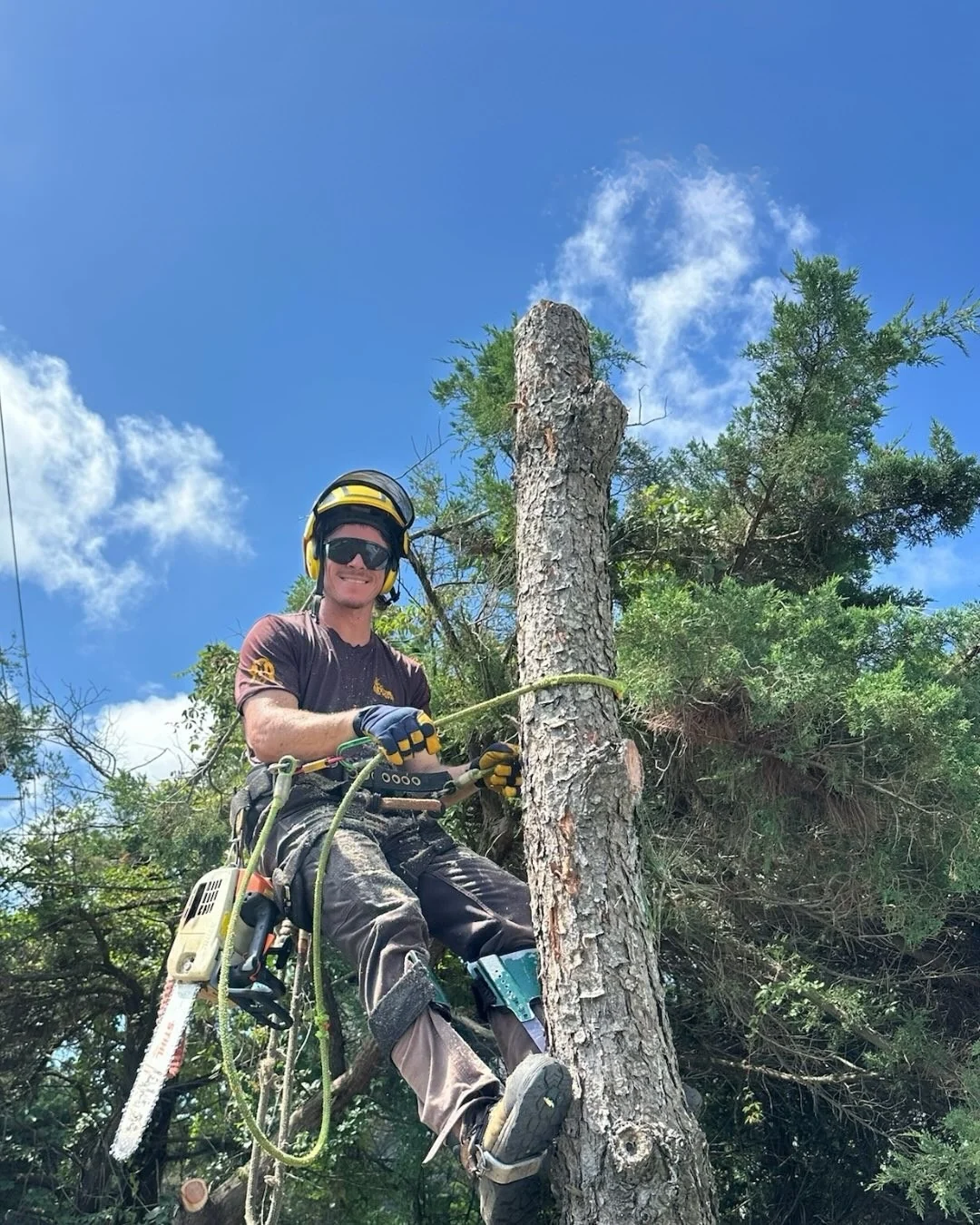
In pieces, from the top down, with each piece lowered on a rope instead of dropped. On the Outer Banks, "close to the house" usually means a few feet from a deck, a roofline up on pilings, a septic field in the drop zone, or a power line running through the canopy.
We walk the property and map where every piece will land, what's under it, and what the crew can't touch. Rose puts it plainly: "All hazards are considered ahead of time, which is what makes the estimate visit so important. A thoughtful plan minimizes potential for critical mistakes."
Altura aims to protect trees that should stay on your property. Taking out the one problem tree shouldn't cost you the stand of trees (yaupon, wax myrtle, and young oaks) around it, because those are what hold your ground together.
Can you clean up the property while you’re here?
Yes, and it's the cheapest time to do it. The crew and the chipper are already on your property, so adding cleanup to a removal costs far less than booking it as a separate trip.
Most houses here are well kept. The trees around the edge of the property usually aren't, and those trees are the first thing anyone sees pulling into the driveway. While we're there, we can pull the vines out of the canopy, take the deadwood out of the trees that are staying, and brush mow the thick growth at the edge so a regular mower can handle it again. The wild parts get shaped, not scraped bare.
Altura calls it manicuring the perimeter.
What does tree removal cost?
The equipment, the crew, and the drive costs more on a barrier island. Skilled work with our equipment runs about $450 an hour. Many removals start around $650 to $750, and chipping-only jobs can run as low as $150 to $200.
Distance adds to cost. A single small job in Nags Head or on Ocracoke is hard to justify on its own, so we group jobs by area. If your neighbor wants a few limbs taken down while we're on your street, it usually costs them less if we are working on other local properties, than it would as a separate individual trip.
A price well under these numbers usually means a red flag and something's being skipped.
Want a real number for your tree? Send us a photo and where it sits, and we'll tell you what size job it is.
Do I need a permit?
Sometimes, and it depends on which town you're in and how close you are to the water. Here's how it breaks down, based on what we see on jobs:
Nags Head. The live oak is the town's official tree, and it's protected. On vacant residential lots, removing any tree more than six inches across at chest height needs an approved land disturbance or building permit. The districts around Jockey's Ridge and Nags Head Woods are stricter: a permit is needed for trees over four inches. If a tree is dead, diseased, or dangerous, the town wants to hear about it first so staff can take a look.
Hatteras Island and Wanchese. These villages aren't incorporated towns. They fall under Dare County Planning, which has an office in Frisco for Hatteras Island.
Near the water, anywhere. On soundfront and oceanfront lots, the state's Coastal Area Management Act can apply. Clearing land as part of construction counts as development in those areas, and cutting coastal wetland vegetation counts as altering the wetland. Either one can require a CAMA permit.
We'll tell you what applies to your lot before we schedule anything.
Can you arrange the work if I’m away?
Yes. Altura is a registered vendor with several Outer Banks property management companies, so we can coordinate the job directly with your manager. That covers access, timing, and sign-off, with no calls back and forth between you and the crew.
Ocracoke works on its own clock. Most owners there rent part time and need the work finished before the season opens, so we book Ocracoke removals early and plan the ferry trip around them. If you manage or own more than one rental, we can fold tree removal into the rest of your property's care.
When would Altura recommend keeping a tree?
When it isn't yours, when it's standing in a protected wetland, or when the plan is to scrape the whole lot bare. Those are the three removals Altura turns down or talks people out of.
Filling or clearing a protected wetland can bring fines on top of the damage. When someone wants everything gone, Altura will make the case for keeping some of the native growth. On a barrier island, roots are what hold the sand in place. Clear all of it, and the wind and rain start carrying the lot away.
Can you remove my neighbour’s tree?
No. Altura puts it this way: you can trim the limbs that hang over onto your property, but you can't remove your neighbor's tree. If branches are crowding your roof or yard from next door, we can trim them back to your property line without harming the tree.
A few more questions
Can I take the branches to the county yard myself?
Only the small stuff. Dare County's residential yard debris site won't take stumps, or limbs thicker than four inches or longer than three feet. Lot-clearing debris has to go to the C&D landfill in Manns Harbor. That's a long haul for a full tree.
Should I pile up the branches before you come?
Yes, if you keep the pile to branches only. No scrap lumber, nails, or trash mixed in, so everything can go straight through the chipper.
Can you remove a tree near power lines?
Yes, with the right safety equipment and training. Bronza holds Electrical Hazards Awareness certification, and the drop zone around the line gets mapped before anything is cut.
What should I do if a tree has already fallen on my house?
Stay out from under it and call us. A tree resting on a roof is often still under tension. That's a job for storm damage cleanup, and we treat it as urgent.
Tell Rose about your tree.
Call Rose at 252-995-2965 and tell us your concerns about the tree and where it sits. Estimates are free and done on site, usually in the hour before sunset. If it's urgent and you're in Nags Head or on Ocracoke, send photos first and we'll tell you where it fits in the schedule. Missed calls get returned the same day, except Sundays.
Every removal is covered by $1 million each in liability, workers' comp, and auto insurance.